Breaking the Myth of Pure Idealism
It is widely acknowledged that ancient Egyptian art followed a canon of proportions and symbolic representation. Human figures were often depicted with composite views—heads in profile, eyes facing forward, torsos frontal, and legs again in profile. This method was not meant to reflect reality as seen by the eye, but rather reality as understood conceptually.
However, exceptions to this rule exist, and they are significant.
The Amarna Period, for example, is frequently cited as a time when artistic conventions shifted dramatically. During this era, art became more fluid, expressive, and naturalistic, showing elongated forms, intimate family scenes, and emotional interactions. Yet, what is often overlooked is that realism in Egyptian art did not begin or end with this period.
Scenes like the transportation of war captives demonstrate that Egyptian artists, even outside the Amarna revolution, were capable of keen observation and emotional storytelling. These artists were not merely copying rigid templates—they were thinkers, observers, and storytellers who infused their work with meaning and realism whenever the subject demanded it.
A Closer Look at the Scene
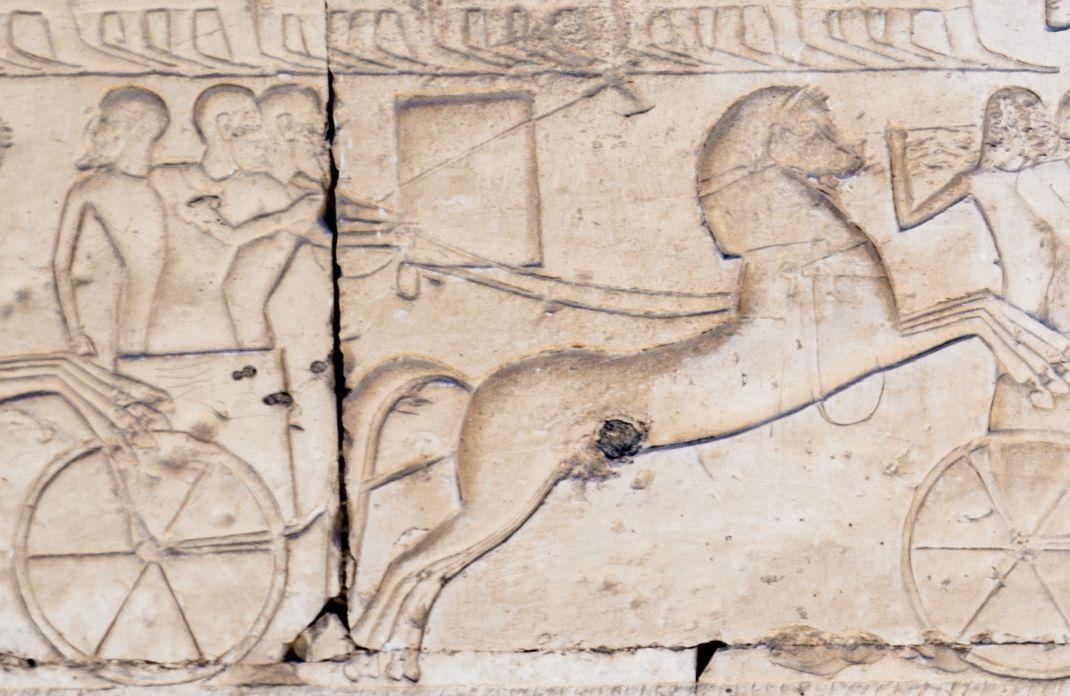
The depiction of two Egyptian soldiers escorting a war captive on a chariot is rich in narrative and symbolism. At first glance, it might appear as a standard victory scene common in temple reliefs and tomb paintings where pharaohs and armies are shown dominating their enemies. However, a deeper examination reveals a more nuanced story.
The soldiers are portrayed with confidence and control, embodying the strength and order of the Egyptian military. Their posture is upright, their grip firm, and their focus forward—symbolizing authority and discipline.
In contrast, the captive tells a completely different story.
His body language is subdued. Unlike the rigid and composed stance of the soldiers, his posture suggests vulnerability. The most striking element is his backward glance. This simple gesture transforms the entire scene. It introduces a moment of humanity that transcends time and culture.
The captive is no longer just an enemy or a symbol of conquest—he becomes a human being experiencing loss. His gaze toward the past evokes a universal emotion: the pain of separation from home, family, and identity.
Emotional Realism in Ancient Egyptian Art
This scene challenges the assumption that ancient Egyptian art lacked emotional depth. While it is true that many depictions were symbolic and idealized, artists were fully capable of representing emotion when the narrative required it.
The backward glance of the captive is a subtle yet powerful artistic choice. It is not exaggerated or dramatic, but it carries immense emotional weight. This restraint is characteristic of Egyptian art, where meaning is often conveyed through small, deliberate details rather than overt expressions.
In this moment, the artist demonstrates an acute awareness of human psychology. The captive’s gesture suggests longing, regret, and perhaps even fear of the unknown future. It invites the viewer to empathize with him, despite his role as an enemy.
Such realism is rare but invaluable. It reveals that Egyptian artists were not confined by their conventions—they knew when to follow them and when to transcend them.
Historical Context: War and Captivity
Scenes of war and captivity were common in ancient Egypt, especially in temple reliefs that celebrated military victories. Pharaohs were often depicted smiting their enemies, reinforcing their divine power and role as protectors of order (Ma’at).
However, the inclusion of a moment like this, where a captive is shown in a vulnerable and emotional state, adds depth to the historical narrative.
It reminds us that behind every victory were real people with real experiences. War was not just a display of power; it involved displacement, suffering, and human consequences.
By capturing this moment, the artist provides a more complete picture of history—one that acknowledges both triumph and tragedy.
The Artist’s Perspective
Ancient Egyptian artists are often viewed as anonymous craftsmen working under strict guidelines. While it is true that they operated within a structured system, this does not mean they lacked creativity or individuality.
On the contrary, scenes like this highlight their artistic intelligence and sensitivity.
The decision to depict the captive looking backward was not accidental. It required observation, empathy, and an understanding of storytelling. The artist chose to include a moment that was not necessary for the official narrative of victory, yet it enriches the scene immensely.
This suggests that Egyptian artists were deeply engaged with their work. They were not just executing orders—they were interpreting and enhancing the stories they were tasked to tell.
Realism Beyond the Amarna Period
The Amarna Period is often celebrated as the pinnacle of realism in Egyptian art, but it should not overshadow other examples.
Realism in Egyptian art existed in various forms and contexts:
These elements demonstrate that realism was not a sudden innovation, but a recurring feature that artists employed selectively.
The scene of transporting a war captive is a perfect example of this selective realism. It shows that even within a largely idealized artistic tradition, there was room for authenticity and emotional truth.
Why This Scene Matters Today
In modern times, we often seek authenticity and emotional connection in art. We value works that make us feel something, that tell human stories, and that reflect real experiences.
This ancient Egyptian scene does exactly that.
Despite being thousands of years old, it resonates with contemporary audiences because it captures a universal moment. The feeling of leaving home, of looking back one last time, is something that transcends culture and time.
It reminds us that people in ancient Egypt were not so different from us. They experienced the same emotions, love, loss, hope, and sorrow.
This connection is what makes ancient art so powerful.
Giving Credit to Ancient Egyptian Artists
It is important to recognize and appreciate the skill and insight of ancient Egyptian artists. Too often, they are reduced to technicians following rigid rules, when in reality they were masters of visual storytelling.
Scenes like this one deserve more attention and recognition. They reveal the depth of Egyptian art and challenge our assumptions about its limitations.
These artists were ahead of their time in many ways. They understood composition, symbolism, and emotion. They knew how to guide the viewer’s eye and evoke a response.
In short, they were true geniuses of their era.
Conclusion
The scene of two Egyptian soldiers transporting a war captive on a chariot is more than just a historical depiction; it is a testament to the realism and emotional depth of ancient Egyptian art.
While the tradition is often characterized by idealism, moments like this prove that Egyptian artists were capable of much more. They could observe, empathize, and represent the human experience with remarkable sensitivity.
The captive’s backward glance transforms the scene from a simple narrative of conquest into a poignant story of loss and longing. It bridges the gap between past and present, reminding us of our shared humanity.
Ultimately, this scene calls for a reevaluation of ancient Egyptian art. It invites us to look beyond the conventions and appreciate the subtle brilliance of the artists who created it.
A little fairness—and admiration—is truly deserved for these timeless masters.
